Between the greenhouse and the stroller
A day in the life of strawberry growers Geert and Heike Rasing
The morning is still crisp as we drive into the yard in Melderslo. Inside the greenhouse, there’s a soft, sweet scent of strawberry plants just beginning to grow. Amid the long rows of greenery, the soft hum of the equipment can be heard. Strawberry farmer Geert Rasing has already been working for a few hours when he walks out to meet us, along with his wife Heike and their eight-month-old daughter Guusje.
“I like to get here early in the morning,” Geert says. “The first thing I do is check the climate control system. I make sure the temperature, humidity, and heating are working exactly as they should.” Then he takes a walk through the greenhouse. “That way, I can immediately see how the crops are doing—for me, that’s actually one of the most important moments as a Grower.” Right now, things are relatively quiet at the farm. The strawberry plants are growing, the greenhouses are ready for the season, and the seasonal workers will be back in a few days. “We’re kind of in the calm before the storm,” Geert says with a laugh. “Just a little while longer, and then things will be bustling here again.”
Two seasons
A strawberry grower’s year has distinct phases. The plants are set out in August. This is followed by weeks of crop maintenance, and the fall harvest begins in late September, continuing until just before Christmas. “After that, the plant goes into winter dormancy,” Geert explains. “The greenhouse gets cold, and the crop goes dormant.” Around February 10, everything starts over. That’s when the heat is turned back on, the old leaves are trimmed, the greenhouse is cleaned, and the crop comes back to life. Starting in April, spring bursts into full swing. “That’s when the busy spring season begins—the main harvest period,” he says. “We pick strawberries until about mid-June; those are really the peak months.” Once the last strawberries of the season have been picked, the greenhouse is cleared out, and a period of maintenance, cleaning, and—briefly—vacation follows. Then it all starts over again. “The work really follows the seasons,” says Geert. “And every phase actually has its own charm.”

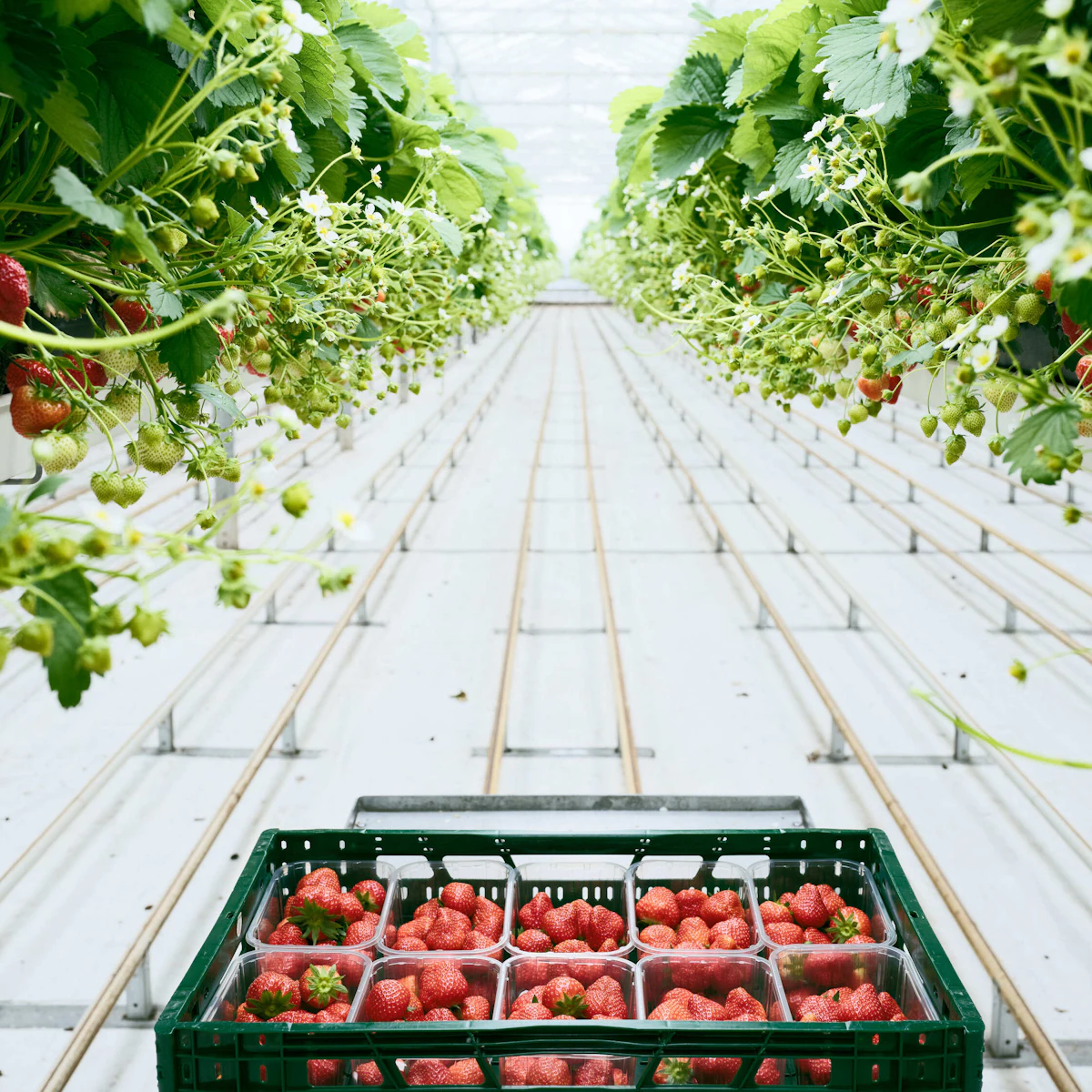
Every morning starts with a walk through the greenhouse; for me, that’s actually one of the most important moments as a grower.
From internship to his own business
Geert grew up on his parents’ mixed-farming operation, which raised pigs and grew field vegetables. So the world of farming was no stranger to him, even though he eventually ended up in a different branch of the industry. “I’ve always been more interested in plants than in animals,” he says. “From a young age, I spent every free hour on my parents’ farm, and I’ve always had the ambition to take over the business.” While studying at HAS University of Applied Sciences, he was introduced to greenhouse horticulture and strawberry farming. That changed his plans. Through his network, he came into contact with Hendrix Aardbeien in Melderslo. “It turned out they didn’t have a successor, so I thought: I know someone who wants to do this—and that’s me!” After graduating in 2018, he started working at the farm—first as an employee, then in a partnership with the previous owners. For four years, they worked step by step to prepare for the transition. “Rob taught me the trade based on his experience,” says Geert. “And in the meantime, I was able to take on more and more responsibilities.” In early 2024, he took full ownership of the business. Shortly thereafter, a second location was added in Tienray. “That worked out well logistically,” he says. “And it allowed us to continue growing.”
Between the greenhouse and family
As Geert talks about the plants, his wife Heike walks into the cafeteria with their eight-month-old daughter, Guusje. There’s a playpen in the office where Guusje can play quietly. Heike works three days a week as an occupational therapist. On her days off, she helps out at the farm, mainly with administration and human resources. “With such a little one, it’s still a bit of a learning curve to see what works,” she says. “Sometimes I work from home, sometimes here at the office.” Farm life isn’t new to her. She grew up on a poultry farm herself. “We never ate at five o’clock there either,” she says with a laugh. “We ate when the work was done.” Still, they think it’s important that everyone can pursue their own passion. “We’ve always said: Heike shouldn’t have to work here just because I happen to grow strawberries,” says Geert. “But she does take on the things she enjoys. That works well.” Guusje is now just part of the family on the farm. “The staff loves it when she’s around,” says Geert. “It creates a positive atmosphere.”


A team of fifty people
During the busiest months, about fifty people work at both locations combined. Most of them come back every year. “We’re really proud of that,” says Geert. “We have a very dedicated team.” The employees come from the Netherlands and Poland and are supported by two foremen and a team leader. They play a vital role in the company. “They speak both Polish and Dutch and are the first point of contact for many employees,” Geert explains. “That makes it easy for people to reach out.” They consider good employment practices important. Housing, transportation, and practical matters are arranged as much as possible for employees who need them. “We try to take the pressure off our people so they can focus on their work.” Their commitment sometimes goes beyond just work. When it became known that Geert and his wife were expecting their first child, the employees came up with a little surprise. “They’d put together a little skit with a baby in a wheelbarrow,” Heike laughs. “It was really lovely to see how they’d organized this together.”
Investing with SIG&F
At night, a special device moves among the strawberry plants: a robot that uses UV-C light to combat fungal spores. A great example of how ZON, together with SIG&F, is strategically investing in new, promising technology. “Mildew is one of the biggest challenges in strawberry cultivation,” explains Geert. “And the range of crop protection products we’re allowed to use is getting smaller and smaller.” The robot combats the fungus with ultraviolet light, which renders the spores harmless. Because sunlight reduces the effectiveness of the treatment, the device primarily travels through the greenhouse at night. “It makes its rounds six nights a week.” This is expected to result in reduced labor, a decrease in the use of crop protection products, and better product quality. Fortunately, the results are promising. “Last season, we used about 65 to 70 percent less crop protection products to control powdery mildew, but it’s still too early to draw conclusions; you have to repeat the process over several seasons first. After all, conditions are different every season,” Geert explains. He doesn’t see himself as someone who blindly follows every innovation. “We do keep a close eye on new developments, but we don’t always have to be the first. We monitor how trials are going at research sites, discuss them with colleagues, and then make a well-considered decision.”
Small moments
On busy days, Geert divides his time between the two locations. He makes rounds through the greenhouse, consults with the foremen, and checks to see if everything is going according to plan. For Geert, the work doesn’t really feel like work, even though he’s busy with it every day. Fortunately, there are also moments of peace. “I always love Sunday mornings,” he says. “It’s really quiet here then,” Heike adds. “Sometimes we walk through the greenhouse together, with the stroller, and we eat a sandwich together and catch up. Those are the special moments.” Geert chuckles. “Other people walk through the woods with a stroller; we walk through our greenhouse.” At the end of the day, Geert checks the computer settings one last time. Then he makes a final round through the greenhouse. “You just want to make sure everything’s in order.” Usually, in the evening, he drives past the Tienray location and then heads home. Heike is often already waiting there with Guusje. “We eat together, give Guusje her last bottle, and put her to bed.” After that, there’s sometimes still time for exercise, a meeting, or an evening with friends in the village. Because besides the business, life outside of it also plays a big role. The couple lives in Veulen, where many of their friends and family live. “We really try to keep Sunday afternoons free,” says Heike. “That’s when we visit family or meet up with friends.” And on Monday, it all starts over again. With a glance at the plants, a walk through the greenhouse, and the knowledge that every day is different. “The best moment of every day is at the end, when I see the cold storage room full of beautiful strawberries,” says Geert, “that’s when I’m always proud of our team, and that’s when I realize, time and again, what it’s all for.”


Other people take walks through the woods with a stroller; we walk through our greenhouse.