Four generations with their hands in the clay
At Visser Agro, it’s not just about growth—it’s mainly about building a future together
As you drive toward the Wieringermeer, the landscape slowly changes. Endless plains, neatly laid-out plots, and long, straight roads that seem to disappear into the horizon. Here, in the northern tip of North Holland, lies Visser Agro. A modern crop farm where seed potatoes, onions, and cauliflower are grown, but where they’re also working on sustainable energy systems, nature fields, and automation. They’ve also developed their own processing division for peeled onions. “There’s actually always a buzz of activity here on the farm,” smiles Anne Visser. “My father-in-law walks around here every day, and Sierd’s sisters still drop by regularly… sometimes I joke that it’s a kind of therapeutic farm.” Together with her husband Sierd, she runs the family business, which now spans four generations.
From Groningen to the Wieringermeer
The history of Visser Agro begins in 1941, shortly after the reclamation of the Wieringermeer. Sierd’s family moved from Groningen to North Holland, seeking more stability. “In Groningen, farmers often switched plots,” Anne explains. “That made it hard to really build something. Here, they had the chance to settle down permanently.” Like many farms at the time, it started as a mixed farm, with cows, field crops, and horticulture. Later, Sierd’s father chose to focus entirely on arable farming, particularly seed potatoes and other rotational crops. When Anne and Sierd met while studying Agricultural Business Administration in Leeuwarden, a new phase slowly began for the business. “We’d actually always wanted to run a business together,” Anne explains. “I was still working at Bejo Zaden at first, but when our third child was born, I started working full-time from home on the farm.” Anne and Sierd now each have their own areas of responsibility within the company. Sierd focuses primarily on field crops, while Anne handles the onion peeling facility and processing. “We both have our own areas of expertise within the company,” says Anne. “But we really do it together.”
The fourth generation
That connection to the business is now also evident in their children, ages ten, eight, and five. “They all want to start working already,” Anne laughs. “Of course, they’re not really allowed to yet, but they love riding along on the tractor and are very curious about how everything grows.” That farming spirit seems to be instilled in them from an early age. “The other day we were driving past a field, and our son suddenly said, ‘Oh, the potatoes are already coming out of the ridges here!’ That’s when you realize they’re already thinking about it.” Meanwhile, the kids are racing around the farmyard on ATVs and go-karts, while trucks come and go in the background. It’s typical of the atmosphere on the farm: professional and large-scale, yet still family-oriented and welcoming. “You really feel like you’re carrying something on for the next generation,” says Anne. “That feeling is truly part of all of us.”


Growing without more land
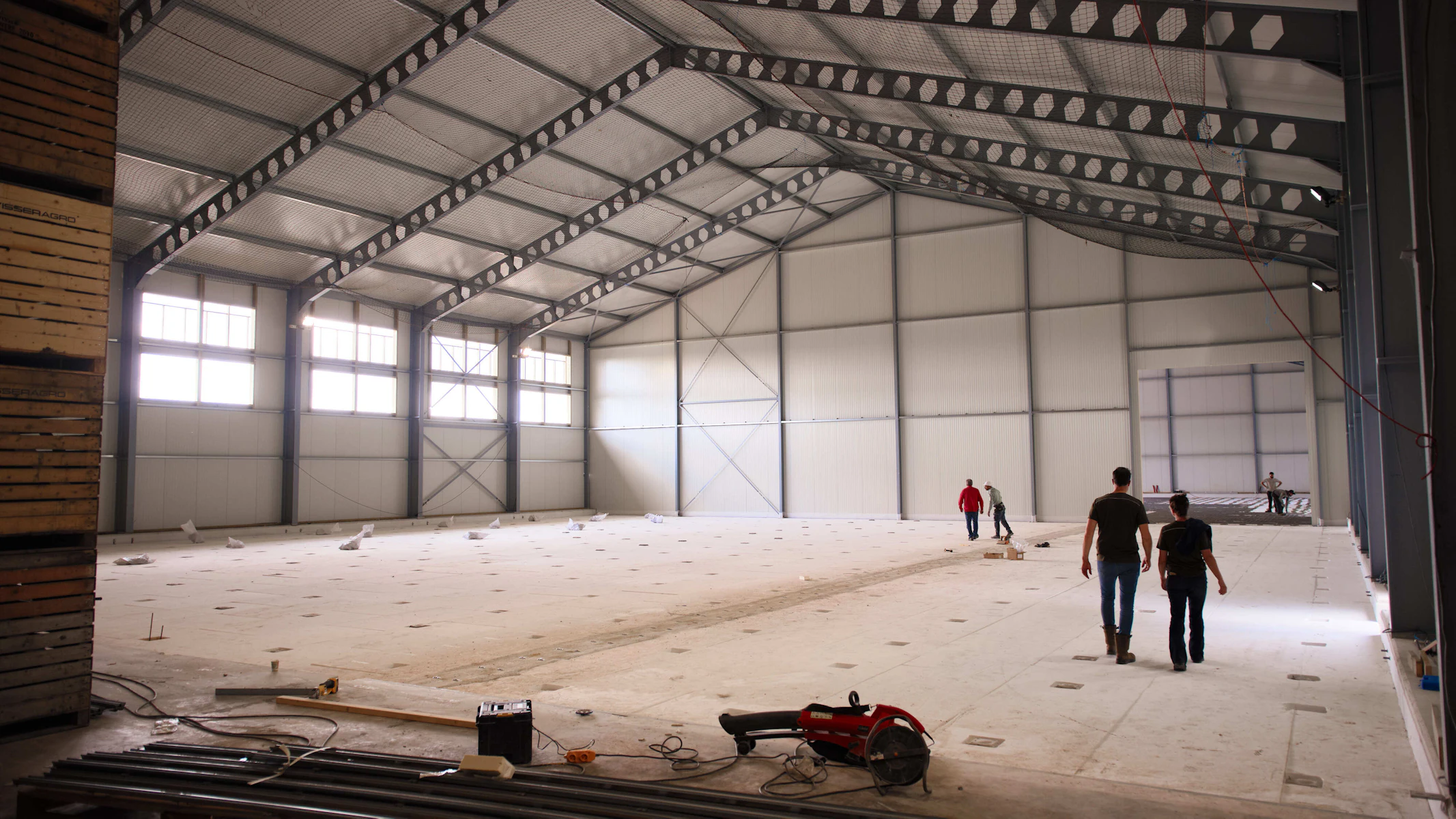
Visser Agro has grown significantly in recent years, but remarkably, not just by acquiring additional farmland. That’s precisely where Anne and Sierd made conscious choices to do things differently. “Land prices are skyrocketing,” says Anne. “Buying more land also means enormous costs and obligations. That’s why we started looking for ways to grow that are less dependent on land. Moreover, we were looking for a solution to the fact that our customers mainly want large-sized onions, which left us stuck with the undersized ones.” That search led, among other things, to the founding of Visser Convenience BV, the company’s own processing division for peeled onions. Through a vegetable processor, they were given the opportunity to supply peeled products in addition to unpeeled onions. That division has since become an increasingly important part of the company. “There’s also a lot of automation involved,” Anne explains. “For us, that’s not just about efficiency, but a way to keep the work manageable and appealing for ourselves and our staff. That doesn’t mean we won’t buy any more land, but the processing division gives the company continuity and provides a solid foundation.” That foundation is important to Visser Agro. “Sierd fell ill in 2022, which sidelined him for most of the next two years,” Anne explains candidly. “During that time, we quietly continued to run the business, and we were able to do so thanks to our progress in processing and automation. We temporarily put a number of projects on hold, but fortunately we now have the capacity to resume them. For example, this year we made the move into cauliflower cultivation. Our motivation is to grow more crops on our own land.”
Robots, air filters, and smarter work practices
Automation now plays a role throughout the entire company. “We mainly invest in systems that take over repetitive work,” she says. “For example, a sorting robot that automatically pre-sorts potatoes and onions. People are increasingly less inclined to do that kind of work all day long.” You can also see this trend in other areas of the farm. New crate-filling systems ensure a calmer working environment and less forklift traffic. They’ve invested in an air extraction system to better remove dust from potatoes and onions. “We’re really doing this for the health of our employees,” says Anne. “It’s not all about cost-benefit analysis.” At the same time, they’re looking ahead to technologies that can reduce the use of crop protection products, such as spot spraying and laser robots. “But those are massive investments,” says Anne. “Some systems cost close to one and a half million euros. So you have to be absolutely sure it works.”
Between ideals and reality
Sustainability plays a major role at Visser Agro, though Anne and Sierd also recognize how complicated that can sometimes be in practice. The company invested in solar panels and large batteries to store energy more efficiently and help reduce grid congestion. In addition, parts of their land are sown with bird fields and winter forage fields for birds, bees, and other animals. “We’re fully behind that, even though in practice it means more weeds and therefore more work for us. The challenge is that sometimes there are fewer flowers, simply because it’s been too dry that year. Then you don’t meet the percentages agreed upon with the agricultural nature conservation association, even though there’s little a grower can do about it.” This immediately illustrates what she believes modern growers are increasingly running into: “Growers have the intention, but regulations sometimes make implementation difficult, and becoming more sustainable requires major investments, while policy is constantly changing,” says Anne. “The Netherlands often wants to be the best student in the class, while competitors in other European countries sometimes have much more flexible rules. Ultimately, the market still tends to focus primarily on price.”


Growers have the intention, but regulations sometimes make implementation difficult, and becoming more sustainable requires major investments, while policies are constantly changing.
The perfect onion
Another challenge for today’s growers is the market’s high standards. Consumers often underestimate how much work and waste go into the perfect product on supermarket shelves. “With onions, you can harvest eighty metric tons per hectare in a good year,” she explains. “But they all grow in different sizes, and the market often wants only that perfect onion measuring 60 millimeters or larger.” Anything outside that range becomes harder to sell, even though the product is technically just fine. “Together, we’ve created a very perfect market,” says Anne. “And I don’t think consumers always realize how much of an impact that has on the entire supply chain.” The convenience sector also requires much more manual labor than people think. “The supermarket is open seven days a week and expects constant freshness,” says Anne. “As a result, everything revolves around shelf life and speed.”
New paths through ZON
The search for new crops and new sales channels ultimately led Visser Agro to ZON. “We’d been looking to expand our sales channels for some time, especially for onions and cauliflower,” says Anne. While some organizations showed little interest in onions, ZON was open to new products and partnerships. “What appealed to us is that ZON has its own sales channels and supports the development of our business,” says Anne. “Sales to existing customers already provide the necessary continuity, but with ZON’s sales channels, we hope to broaden our horizons even further.” Looking back, she’s still a little surprised at how quickly the partnership came together. “We made initial contact in December, were in Venlo in January, and shortly after that we’d already ordered our first cauliflower plants!”
Together, we go further
Despite all the growth, investments, and technology, Anne and Sierd believe the company is ultimately still all about people. “We’re not afraid of having staff. It’s precisely thanks to good people that we’re able to free up time—to go on vacation once in a while, to take a breather, and to keep building our business.” And perhaps that’s the common thread running through Visser Agro: continuing to grow without losing sight of the human element. “In ten years, we hope above all to be proud of how we’ve done it together,” says Anne. “That we’ve continued to seize opportunities, that we can pass the company on in good health to future generations, and that people still enjoy working here and coming home.”