Peace, routine, and authentic Brussels sprouts
A day in the life of Brussels sprout growers Chrit and Niek Bertjens
It’s a clear morning along the Graeterweg in Swalmen as we walk onto the Bertjens family’s property. In the distance, you can hear a machine humming. The air smells of wet earth and that kind of crisp chill that hangs only over farmland. We’re greeted by father Chrit, who takes us to the shed. Inside, Niek is already hard at work, along with the three Romanian employees—Daniël, Valli, and Julia. They seem calm and are a bit shy, but every movement is purposeful: everyone knows exactly what they’re doing. There’s a peaceful atmosphere; it’s one of those days when everything runs smoothly.
Happy accident
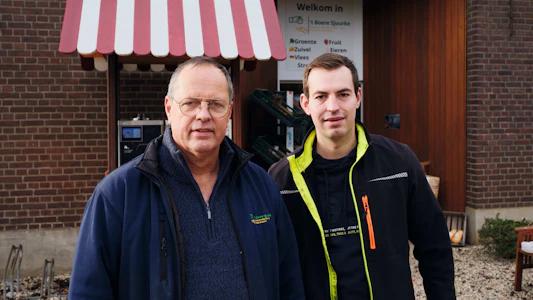
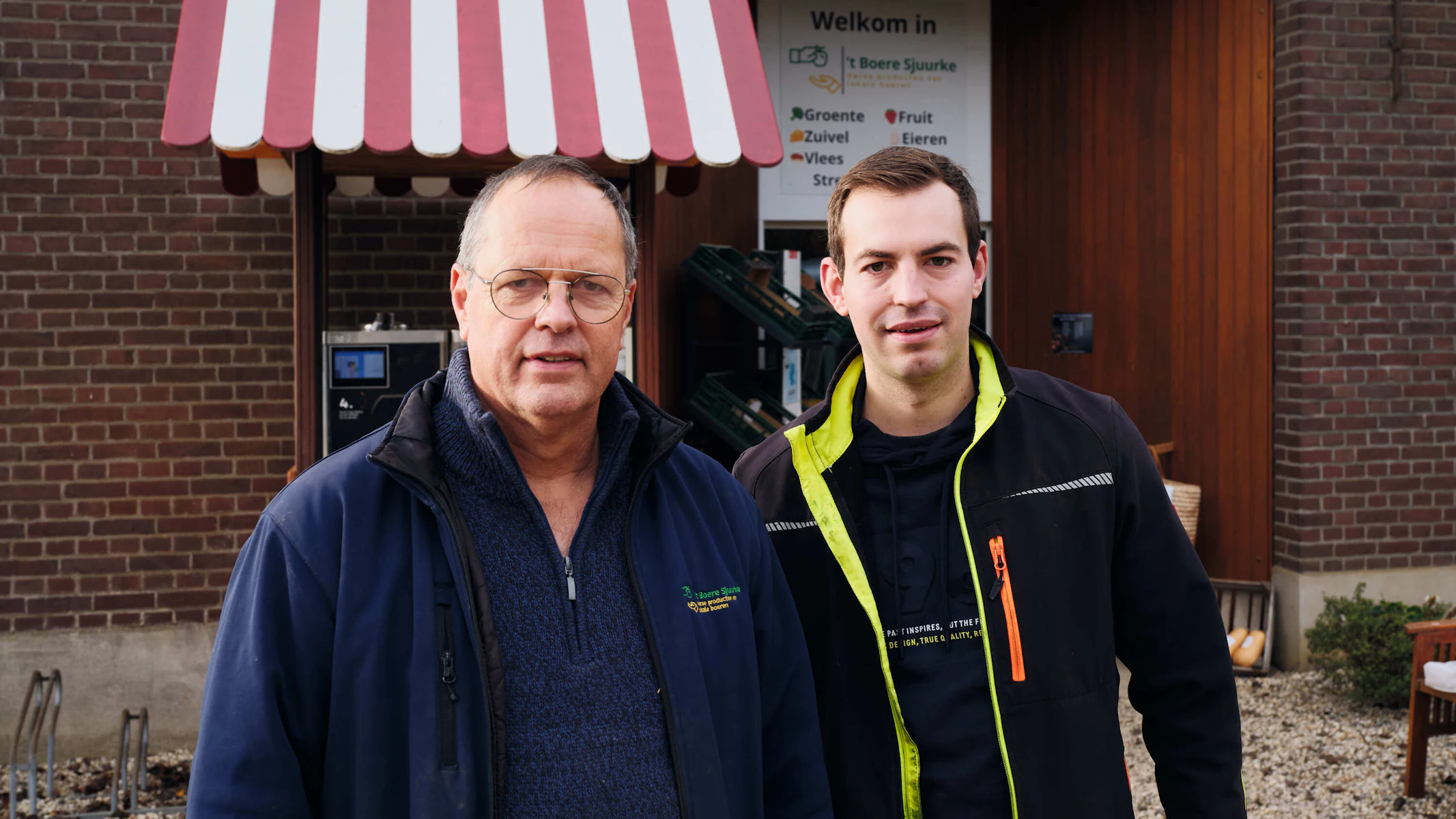
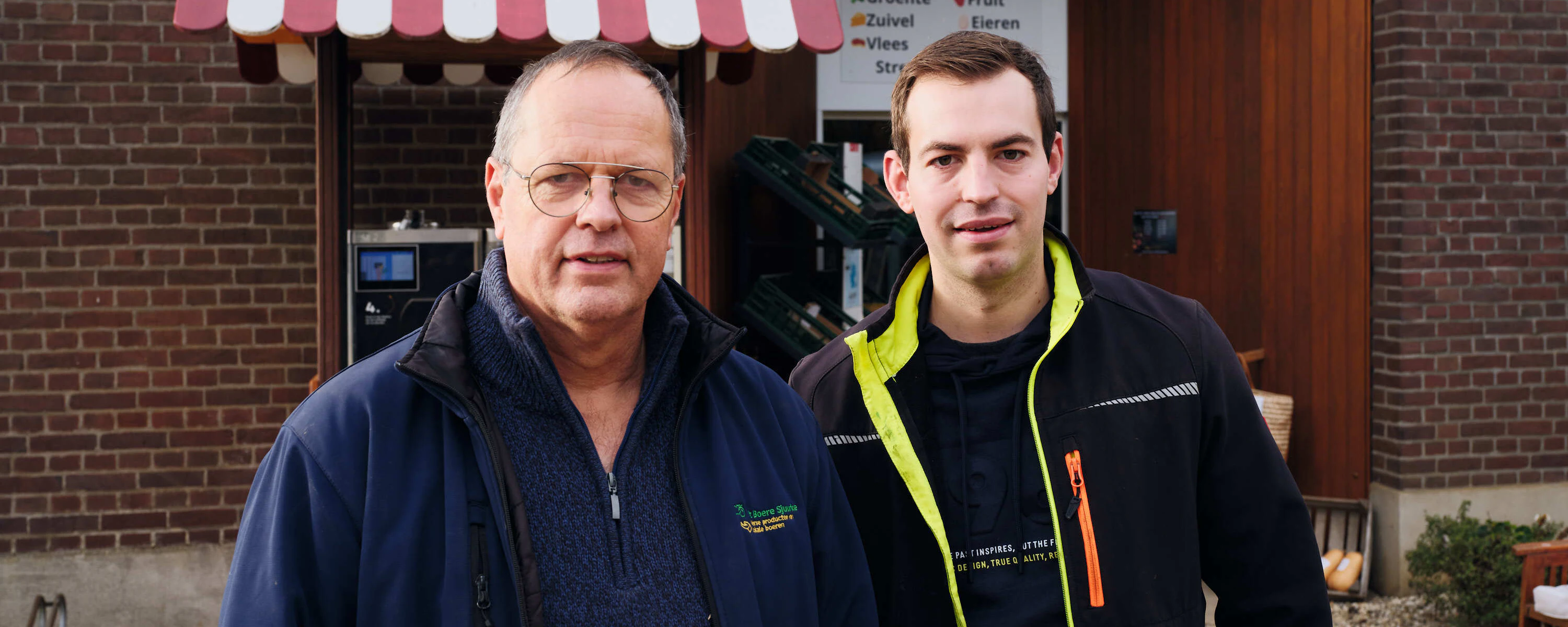
Chrit is working in the store today. “That’s actually how we always start,” he says as he straightens out some bags of Brussels sprouts. The store, called ’t Boeresjuurke, is warm and cozy, stocked, of course, with fresh Brussels sprouts, but also meat, vegetables, jam, and local products neatly displayed, as well as ice cream for the kids who stop by after school. The products come mainly from the region and often have their own story. “It all started with a little mistake,” Chrit laughs. “We once accidentally had cauliflower mixed in with the Brussels sprouts. Niek and his sister sold it by the roadside, along with a little jar. And it sold like hotcakes.” It was a “happy accident” that opened a new chapter. The idea of running their own farm shop right at home had always stayed with Niek, and three years ago, they were finally able to make it a reality. It’s a shop that people from all over the region—even from Germany—now make a detour for. A store that literally keeps Chrit on his feet. Because since his back surgery three years ago, he can no longer do heavy labor, but here in the store he finds rhythm, connection, and pride. “This is my therapy,” he says, as he straightens boxes of artisanal flans.
Caught on camera
In the warehouse, the sorting belts are running at full speed. Taking center stage in the room is an impressive, almost futuristic machine, the so-called Sproutcam. “The machine can sort about 5,000 kilograms of Brussels sprouts per hour,” Chrit explains proudly. At a breakneck pace, the machine takes 16 photos of every Brussels sprout that passes by. Any sprout that isn’t perfectly round or nicely closed is blown off the conveyor belt with a burst of air. “Without that machine, we wouldn’t be sprout growers anymore,” Chrit adds. “The standard everywhere is that, out of every 100 sprouts, only 5 may deviate from the norm. If we had to sort them by hand, it would take too much time. A relatively large amount is currently being lost, but consumers don’t want sprouts with spots or blemishes. Fortunately, we can reuse everything that’s sorted out as growing medium for new sprouts.”


A passion for the work
By around 11 a.m., today’s sprouts have been sorted, and it’s time for a break. The three employees retreat for a moment to their own little cottage on the farm, where they’ve been living for a large part of the year for several years now. They cook a meal and then get ready for the day’s fieldwork: harvesting the sprouts. “They’ve been working for us for several seasons now, and we’re very satisfied,” says Chrit. “They know exactly what needs to be done and are free to plan their work as they see fit. Sometimes the work is finished earlier, other times a bit later. We don’t sweat an extra hour, and neither do they. That works well for all of us.” While the Romanians take a break, Niek and Chrit also have a moment for a cup of coffee. We walk into the farmhouse, which is over 100 years old. “My grandmother came to live here as a little girl around 1914, and it’s stayed in the family ever since,” Chrit says proudly. “My parents ran a mixed farm with pigs, and I took it over. Then Niek started working for me at a young age, partly because our daughter—his sister—had been sick for a while. Fortunately, she’s doing well again now.” Niek had to step in a lot during that time, and later when Chrit’s back problems began as well. “It was quite a lot at times, but I like to work hard and always do the work with love,” says Niek. “Sometimes I have a little less free time than my friends—for example, when we’re building our carnival float—but I usually manage to make time for that too. And of course, I always make time for my girlfriend, whom I see every Wednesday and on the weekends,” Niek smiles.
A new direction
Then the two talk about their decision to get rid of the pigs and focus entirely on growing Brussels sprouts and other cabbage varieties. “When my father got sick, during the COVID-19 pandemic, I started thinking about the future,” says Niek. “Having my own farm store was something I’d always wanted, so we set to work on that. Besides, it seemed wise to me to specialize in Brussels sprouts and other types of cabbage, such as broccoli. That way, I can build up my knowledge of this crop and purchase the specialized machinery we need.” Father Chrit looks at his son and nods approvingly. “When he shared his ideas, I was skeptical at first, but after thinking it over for a moment, I had to agree with him—it was a good plan. Brussels sprouts are one of the most difficult crops to grow. They’re finicky, and everything has to be just right. First of all, you need good clay soil; otherwise, you’re out of luck. Next, the plant needs exactly the right amount of light and water at exactly the right time to ensure it grows nice and upright and then produces beautiful sprouts.” Chrit continues: “By specializing in this, we’ve established a strong position. Cultivation has only become more difficult due to the increasingly strict regulations. When my father started growing sprouts, there were 27 sprout growers in Limburg; now we’re the only ones left.”


Back with ZON
The Bertjens family recently rejoined ZON. For Chrit, it almost feels like coming home, even though he wasn’t always entirely satisfied in the past. “Back then, I felt that ZON was primarily an organization for the Customer, not for the Grower,” he says honestly. But in recent years, he’s seen a change. More attention to the grower, short lines of communication, and engagement. “ZON has really moved in the right direction,” he explains. That’s why he felt confident taking this step back. ZON offers a warm connection, established structures, clear agreements, and understands how sprout cultivation works. “It gives me peace of mind,” says Chrit. “At ZON, we know where we stand, and that just makes for a pleasant working relationship.”


Small Brussels sprouts
Chrit’s wife, Ilse, makes sure there’s a tasty meal ready during the lunch break. “If she has a late shift, we eat a hot meal already at noon,” says Niek. “She works in the Neonatology department at the hospital in Roermond, where she cares for premature babies—the tiniest sprouts, so to speak,” he smiles. It’s a world that’s completely different from the fields and machines back home, but she approaches it with the same calm and dedication to her craft. Her work, too, is a calling, just like that of her husband and son. Then there’s their daughter Fleur, who has since left the nest and is building a future of her own. She’s only 25, but has already completed several degrees—including studies in South Africa—works hard, and leads a life that’s almost the polar opposite of the rhythm of the farm where she grew up.
Going about his business
Meanwhile, the three Romanian workers are getting started on their tasks in the field. They know the ropes, understand what needs to be done, and carry out their work with obvious enjoyment. Chrit steps outside for a moment and looks out over the fields before heading back into the store. He talks about the harvesting machine, which takes a lot of the work off their hands, but notes that manual labor is still necessary to maintain the quality they aim to deliver. Inside, Niek is driving pallets of Brussels sprouts to the cold storage. He works steadily, without rushing but also without stopping. Whenever needed, he and his father constantly switch between the field, the warehouse, and the store. “We just complement each other,” says Chrit. “I do what I can, and he picks up where I can’t keep up.” Later in the afternoon, the Brussels sprouts are loaded for the auction. “That’s just part of the day,” says Niek, as he checks the last crates. “If we can drive a nice load of Brussels sprouts to the auction in our own truck, our day has been a success again!” Niek smiles proudly. At the end of the day, everything is prepared for the next morning—both in the store and in the warehouse—and the yard is tidy once again. Tomorrow, it all starts over again. Just as it should be, at a family farm that’s been around for generations, with a love for a finicky crop that almost no modern farmer dares to grow anymore.


My grandmother came to live here as a little girl around 1914, and it’s been in the family ever since.
Read more here!